Interest is an important part of many financial calculations. Whether you are borrowing money, saving money, or comparing different financial products, understanding how interest works can help you see how the amount changes over time.
Two common types of interest are simple interest and compound interest. Both are based on an initial amount, an interest rate, and a period of time, but they calculate interest differently.
The main difference is straightforward: simple interest is calculated only on the original principal, while compound interest can be calculated on the principal plus previously added interest.
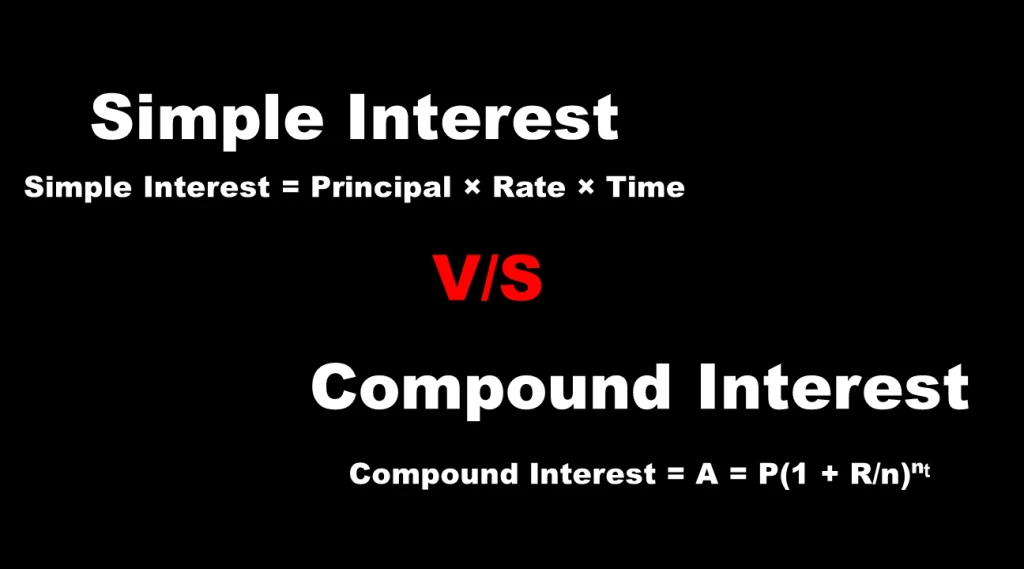
In this guide, we will explain both types of interest with simple formulas and examples, compare them side by side, and show when each calculation may be useful.
What Is Simple Interest?
Simple interest is interest calculated only on the original principal amount.
The interest does not get added to the principal when calculating the interest for the next period.
The basic simple interest formula is:
Simple Interest = (P × R × T) ÷ 100
Where:
- P = Principal amount
- R = Annual interest rate
- T = Time period in years
The total amount after the interest is added can be calculated as:
Total Amount = Principal + Simple Interest
Simple Interest Example
Suppose you deposit or invest ₹10,000 at an annual interest rate of 5% for 3 years.
Using the formula:
Simple Interest = (10,000 × 5 × 3) ÷ 100
= ₹1,500
The total amount becomes:
₹10,000 + ₹1,500 = ₹11,500
So, the interest earned over three years is ₹1,500.
You can also use the Simple Interest Calculator on NexCalco to calculate simple interest quickly.
What Is Compound Interest?
Compound interest is calculated on the principal amount as well as interest that has already been added to the account.
This means that over time, you can earn interest on previously accumulated interest.
The standard compound interest formula is:
A = P(1 + R/n)ⁿᵗ
Where:
- A = Final amount
- P = Principal amount
- R = Annual interest rate expressed as a decimal
- n = Number of times interest is compounded per year
- t = Time in years
The compound interest itself can then be found using:
Compound Interest = A − P
Compound Interest Example
Suppose you invest ₹10,000 at an annual interest rate of 5%, compounded annually, for 3 years.
The calculation is:
A = ₹10,000 × (1 + 0.05)³
The final amount is approximately:
₹11,576.25
Therefore, the compound interest is approximately:
₹11,576.25 − ₹10,000 = ₹1,576.25
So, the interest earned is approximately ₹1,576.25.
For a quick calculation, you can use the Compound Interest Calculator on NexCalco.
Simple Interest vs Compound Interest
The biggest difference between the two is how the interest is calculated over time.
With simple interest, interest is always calculated using the original principal.
With compound interest, previously accumulated interest can become part of the amount on which future interest is calculated.
| Feature | Simple Interest | Compound Interest |
|---|---|---|
| Interest calculated on | Original principal | Principal plus accumulated interest |
| Interest on previous interest | No | Yes, depending on compounding |
| Growth over time | More linear | Can grow faster over time |
| Formula | P × R × T ÷ 100 | P(1 + R/n)ⁿᵗ |
| Effect of longer periods | More predictable | Compounding can have a larger effect |
Why Compound Interest Can Grow Faster
The difference between simple and compound interest may be small over a short period, but it can become more noticeable as the time period increases.
Consider an investment of ₹10,000 at 5% per year.
With simple interest, the interest earned each year remains ₹500 because the calculation continues to use the original ₹10,000.
With annual compounding, the interest can increase because each year’s interest becomes part of the balance.
For example:
Year 1: ₹10,000 → ₹10,500
Year 2: ₹10,500 → ₹11,025
Year 3: ₹11,025 → ₹11,576.25
The amount earning interest increases each year.
This is the basic idea behind compounding.
Example: Simple Interest vs Compound Interest
Let’s compare both methods using the same starting amount, interest rate, and time period.
Suppose:
- Principal = ₹20,000
- Interest rate = 6% per year
- Time = 5 years
Simple Interest
SI = (20,000 × 6 × 5) ÷ 100
SI = ₹6,000
Total amount:
₹20,000 + ₹6,000 = ₹26,000
Compound Interest
If the interest is compounded annually:
A = 20,000 × (1.06)⁵
The final amount is approximately:
₹26,764.51
Compound interest:
₹26,764.51 − ₹20,000 = ₹6,764.51
In this example:
- Simple interest = ₹6,000
- Compound interest = ₹6,764.51
The difference is approximately ₹764.51.
The longer the money remains invested or the more frequently interest is compounded, the more important the difference can become.
What Does Compounding Frequency Mean?
Compound interest can be calculated at different intervals.
Common compounding frequencies include:
- Annually
- Half-yearly
- Quarterly
- Monthly
- Daily
For example, if interest is compounded annually, it is added once each year.
If it is compounded monthly, the calculation is performed more frequently.
The compounding frequency can affect the final amount because the accumulated interest can start earning additional interest sooner.
Annual vs Monthly Compounding
Suppose you invest money at a fixed annual rate.
With annual compounding, interest is added once a year.
With monthly compounding, interest is calculated and added every month.
For the same nominal annual rate and investment period, more frequent compounding can result in a different final amount.
This is why it is important to check not just the advertised interest rate but also how frequently the interest is compounded.
How to Calculate Simple Interest
Calculating simple interest involves three main pieces of information:
- Principal
- Interest rate
- Time
For example:
Principal = ₹5,000
Rate = 8%
Time = 2 years
Apply the formula:
SI = (5,000 × 8 × 2) ÷ 100
SI = ₹800
The total amount is:
₹5,000 + ₹800 = ₹5,800
How to Calculate Compound Interest
For compound interest, you need:
- Principal
- Interest rate
- Time
- Compounding frequency
For example, suppose:
Principal = ₹5,000
Annual rate = 8%
Time = 2 years
Compounding = annually
The formula is:
A = P(1 + R/n)ⁿᵗ
Since the interest is compounded once a year:
n = 1
So:
A = 5,000 × (1 + 0.08)²
A = 5,832
The compound interest is:
₹5,832 − ₹5,000 = ₹832
When Is Simple Interest Used?
Simple interest is often useful for straightforward calculations where interest is based only on the original principal.
It can be used for certain types of loans, short-term financial calculations, and educational examples.
However, the actual method used by a financial product depends on its specific terms. You should always check the agreement or product details rather than assuming that a particular loan or investment uses simple interest.
When Is Compound Interest Used?
Compound interest is commonly associated with financial situations where accumulated interest can become part of the balance used for future interest calculations.
It is particularly important when looking at savings and investments over longer periods.
The effect of compounding can become significant because the balance can grow over time, allowing subsequent interest calculations to be based on a larger amount.
Simple Interest vs Compound Interest for Borrowers
The difference between simple and compound interest is also important when borrowing money.
The actual interest calculation for a loan depends on the lender and the loan agreement. Some loans use reducing-balance calculations rather than a basic simple-interest formula.
Therefore, borrowers should not assume that the simple or compound interest formulas alone describe every loan.
Before taking a loan, check:
- Interest rate
- How interest is calculated
- Repayment schedule
- Loan tenure
- Processing fees
- Prepayment conditions
- Total repayment amount
The total repayment figure is often more useful for comparing loan costs than looking at the interest rate alone.
Simple Interest vs Compound Interest for Savings
For savings and investments, compounding can make a significant difference over longer periods.
Suppose you leave money invested and allow the interest to remain in the account. Future interest may then be calculated on both your original money and the accumulated interest, depending on the product’s terms.
This is why people often talk about the importance of starting early when saving or investing.
Even when the annual rate stays the same, the effect of repeated compounding can cause the balance to grow at an increasing rate.
Advantages of Simple Interest
Some characteristics of simple interest include:
- Easy to calculate
- Easy to understand
- Interest is based on the original principal
- Useful for straightforward calculations
- Does not depend on previously accumulated interest
The main feature is its simplicity.
Advantages of Compound Interest
Compound interest has a different structure and can have a stronger effect over longer periods.
Some characteristics include:
- Previously accumulated interest can contribute to future growth
- Longer periods can increase the effect of compounding
- More frequent compounding can affect the final amount
- Useful for understanding long-term growth
However, whether compounding benefits you depends on whether you are earning interest or paying it.
Compound Interest Can Work Both Ways
Compound interest is often discussed in the context of growing savings, but the same principle can increase the cost of certain types of borrowing when unpaid interest is added to the balance under the terms of the agreement.
For a saver, compounding can increase the amount earned.
For a borrower, compounding or interest capitalization can increase the amount owed.
This is why it is important to understand how a particular financial product calculates and applies interest.
Common Mistakes When Calculating Interest
Using the Wrong Interest Rate
Make sure you use the correct annual or periodic interest rate required by the formula.
Forgetting to Convert the Rate
If a compound interest formula requires a decimal rate, convert the percentage first.
For example:
6% = 0.06
Not 6.
Using the Wrong Time Period
If the interest rate is annual, make sure the time period is expressed appropriately in years unless the formula is adjusted for another period.
Ignoring Compounding Frequency
For compound interest, check whether the interest is compounded annually, monthly, quarterly, or at another interval.
Looking Only at the Interest Rate
The rate is important, but fees, compounding frequency, tenure, and other terms can also affect the final amount.
Simple Interest vs Compound Interest: Which Formula Should You Use?
It depends on the type of calculation you are trying to make.
Use the simple interest formula when the calculation specifies that interest is based only on the original principal.
Use the compound interest formula when interest is added to the balance and future interest is calculated on the accumulated amount.
Always check the terms of the financial product before choosing a formula.
Use a Simple Interest Calculator
If you want to calculate simple interest without doing the formula manually, you can use the Simple Interest Calculator on NexCalco.
You can enter the principal, interest rate, and time period to quickly estimate the interest and total amount.
Use a Compound Interest Calculator
For compound interest calculations, you can use the Compound Interest Calculator on NexCalco.
It can help you calculate the estimated final amount and interest based on the principal, rate, time period, and compounding frequency.
Final Thoughts
Simple interest and compound interest both calculate the cost or growth of money, but they work in different ways.
With simple interest, the calculation is based on the original principal. With compound interest, previously accumulated interest can become part of the balance used for future calculations.
The difference may seem small when looking at a short period, but compounding can have a much greater effect over longer periods.
Before making a financial decision, look beyond the interest rate and check how the interest is calculated, how often it is applied, the repayment or investment period, and any additional charges.