Buying a car is a major financial decision, and the monthly loan payment is one of the most important things to consider before making a purchase. A car may fit your budget based on its price, but the monthly EMI can tell you whether the loan will be comfortable to manage over time.
Before visiting a dealer or applying for a car loan, it is useful to estimate your EMI. This allows you to compare different loan amounts, interest rates, and repayment periods before making a decision.
In this guide, we will explain what car loan EMI means, how to calculate it, what factors affect your monthly payment, and how you can reduce the overall cost of the loan.
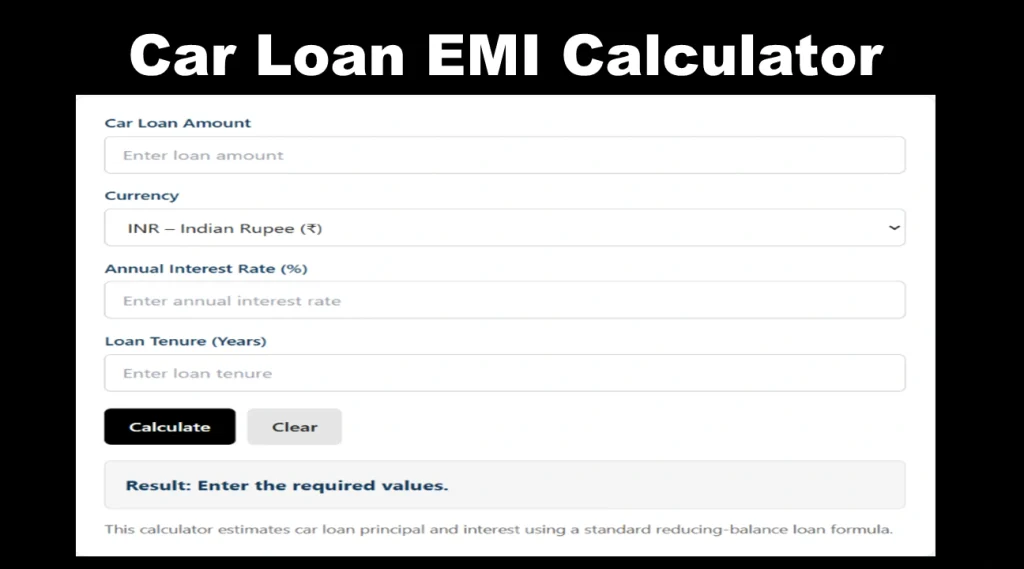
If you want to calculate your monthly payment quickly, you can use the Car Loan EMI Calculator on NexCalco.
What Is Car Loan EMI?
EMI stands for Equated Monthly Instalment. It is the amount you pay to the lender every month until your car loan is completely repaid.
A typical EMI contains two parts:
- Principal: The portion that reduces the amount you borrowed.
- Interest: The amount charged by the lender for providing the loan.
At the beginning of the loan, a larger portion of the EMI generally goes toward interest. As the outstanding loan balance decreases, the interest component also reduces.
Your EMI depends mainly on three things:
- Loan amount
- Interest rate
- Loan tenure
Changing any of these can change your monthly payment and the total interest you pay.
Car Loan EMI Formula
The standard EMI formula is:
EMI = P × R × (1 + R)ⁿ ÷ [(1 + R)ⁿ − 1]
Where:
- P = Principal loan amount
- R = Monthly interest rate
- N = Number of monthly instalments
Because the interest rate is usually given as an annual percentage, it needs to be converted into a monthly rate before using the formula.
For example, if the annual interest rate is 9%, the monthly rate is:
9 ÷ 12 ÷ 100 = 0.0075
The loan tenure also needs to be converted into months.
A 5-year loan, for example, has:
5 × 12 = 60 months
Example of Car Loan EMI Calculation
Suppose you are planning to take a car loan with these details:
- Loan amount: ₹8,00,000
- Annual interest rate: 9%
- Loan tenure: 5 years
First, convert the annual interest rate into a monthly rate:
9 ÷ 12 ÷ 100 = 0.0075
The loan has:
5 × 12 = 60 monthly payments
Using the EMI formula, the monthly payment is approximately ₹16,607.
So, you would pay around ₹16,607 per month for 60 months.
The exact amount can vary depending on the lender’s calculation method, applicable charges, and the final loan terms.
How Much Will You Pay in Total?
Knowing the EMI alone is not enough. You should also look at the total amount you will pay during the loan period.
Using the example above:
Monthly EMI ≈ ₹16,607
Number of payments = 60
Therefore:
Total payments ≈ ₹16,607 × 60
Total payments ≈ ₹9,96,420
The approximate interest paid would be:
₹9,96,420 − ₹8,00,000 = ₹1,96,420
So, a loan of ₹8 lakh at the assumed rate and tenure would cost approximately ₹1.96 lakh in interest over five years, excluding any separate fees or charges.
How Down Payment Affects Your Car Loan EMI
The down payment is the amount you pay toward the car from your own funds before taking the loan.
For example, suppose the car costs ₹10 lakh and you make a ₹2 lakh down payment.
The remaining amount would be:
₹10,00,000 − ₹2,00,000 = ₹8,00,000
You would then need a loan of ₹8 lakh instead of ₹10 lakh.
A larger down payment generally means a smaller loan amount. This can reduce both the monthly EMI and the total interest paid over the loan period.
However, you should also make sure that the down payment does not leave you without enough money for other important expenses or financial needs.
How Interest Rate Affects Car Loan EMI
The interest rate has a direct effect on your loan cost.
For example, suppose you borrow ₹8 lakh for five years. A lower interest rate can result in a lower EMI and less total interest, while a higher rate can increase both.
Even a small difference in the interest rate can matter when the loan runs for several years.
This is why it is useful to compare loan offers rather than looking only at the advertised EMI.
How Loan Tenure Affects EMI
Loan tenure is the length of time you take to repay the loan.
Common loan periods can range from a few years to several years, depending on the lender and loan terms.
A longer tenure usually reduces the monthly EMI because the repayment is spread across more months.
However, there is a trade-off.
Shorter Loan Tenure
A shorter loan period generally means:
- Higher monthly EMI
- Faster repayment
- Less time paying interest
- Potentially lower total interest cost
Longer Loan Tenure
A longer loan period generally means:
- Lower monthly EMI
- More monthly payments
- Longer repayment period
- Potentially higher total interest cost
For this reason, choosing the lowest EMI is not always enough. You should also check the total amount you will pay over the entire loan.
How to Calculate EMI Before Buying a Car
You can estimate your car loan EMI before you decide which car to buy.
Follow these steps:
Step 1: Find the Car Price
Start with the price of the car you are considering.
Remember that the amount you actually need to finance may be different from the displayed vehicle price because additional costs can apply.
Step 2: Decide Your Down Payment
Determine how much you can comfortably pay upfront.
The larger the down payment, the smaller the loan amount will be.
Step 3: Calculate the Loan Amount
Subtract the down payment from the amount you plan to finance.
For example:
Amount to finance = ₹10,00,000
Down payment = ₹2,00,000
Loan amount = ₹8,00,000
Step 4: Check the Interest Rate
Find out the annual interest rate offered by the lender.
Try to compare the actual loan terms rather than relying only on a promotional rate.
Step 5: Choose a Loan Tenure
Decide how long you want to take to repay the loan.
A shorter tenure may increase the monthly payment, while a longer tenure may increase the total interest cost.
Step 6: Calculate the EMI
Enter the loan amount, interest rate, and tenure into an EMI calculator.
You can use the Car Loan EMI Calculator on NexCalco to estimate the monthly payment.
Example: Comparing Different Loan Tenures
Suppose you borrow ₹8 lakh at an annual interest rate of 9%.
The approximate EMI changes as the repayment period changes.
| Loan Tenure | Approximate Monthly EMI | Approximate Total Interest |
|---|---|---|
| 3 years | ₹25,440 | ₹1.16 lakh |
| 4 years | ₹19,908 | ₹1.56 lakh |
| 5 years | ₹16,607 | ₹1.96 lakh |
| 6 years | ₹14,420 | ₹2.38 lakh |
These figures are illustrative calculations based on the stated loan amount and interest rate and exclude separate fees or charges.
The comparison shows an important point: extending the tenure can reduce the monthly EMI, but the total interest paid can increase.
Why You Should Calculate EMI Before Buying a Car
Checking the EMI before buying helps you understand whether the loan fits your monthly budget.
It can help you:
- Set a realistic car budget
- Compare different loan amounts
- Compare repayment periods
- Understand the impact of interest rates
- Estimate total interest
- Decide how much down payment to make
- Avoid choosing a car that stretches your finances too far
Instead of starting with the question, “Which car can I buy?”, it can be useful to first ask, “What monthly payment can I comfortably manage?”
Don’t Look Only at the EMI
A low EMI can sometimes look attractive because the monthly payment is smaller. But it may be the result of a longer loan tenure.
For example, extending a loan from five years to seven years can reduce the monthly payment, but you may make many more payments and pay more interest overall.
Before accepting a loan, look at both:
Monthly EMI + Total repayment amount
This gives you a clearer picture of the actual cost of borrowing.
Other Costs to Consider When Buying a Car
The EMI is only one part of the cost of owning a car.
Depending on your situation, you may also need to consider:
- Down payment
- Insurance
- Registration and related charges
- Fuel or charging costs
- Regular servicing
- Repairs and maintenance
- Parking expenses
- Loan processing fees
- Other lender charges
Including these expenses in your budget can give you a more realistic idea of what the car will cost each month.
Tips to Make Car Loan Repayment Easier
Make a Sensible Down Payment
A reasonable down payment can reduce the amount you need to borrow. However, avoid using all your available savings just to reduce the loan.
Compare Interest Rates
Check offers from different lenders and compare the complete loan terms.
Choose the Tenure Carefully
Do not automatically choose the longest tenure simply because it gives you the lowest EMI.
Compare the monthly payment with the total interest before deciding.
Check Additional Charges
Look beyond the interest rate. Processing fees, prepayment conditions, and other charges can affect the overall cost of a loan.
Keep Some Financial Cushion
Your car EMI should leave enough room in your monthly budget for regular expenses, emergencies, and other financial commitments.
What Happens If You Make a Larger Down Payment?
Suppose you are buying a car for ₹12 lakh.
If you make a ₹3 lakh down payment, the remaining loan requirement may be ₹9 lakh.
If you instead make a ₹4 lakh down payment, the loan may fall to ₹8 lakh.
The lower loan amount can reduce the monthly EMI and the amount of interest paid over the repayment period.
However, the right down payment depends on your own finances. It is important to balance the upfront payment with the cash you need to keep available.
Use a Car Loan EMI Calculator
Calculating EMI manually is useful for understanding how the formula works, but an online calculator can make comparisons much faster.
The Car Loan EMI Calculator on NexCalco can help you estimate your monthly car loan payment based on the loan amount, interest rate, and repayment tenure.
You can change the numbers to see how a different loan amount or tenure affects the estimated EMI.
Final Thoughts
Calculating your car loan EMI before buying a car can help you understand the financial commitment involved. The three main factors to look at are the loan amount, interest rate, and loan tenure.
Do not judge a loan only by its monthly EMI. Check the total repayment and interest as well. A slightly higher EMI with a shorter tenure may result in less interest overall, while a longer tenure may make monthly payments easier but increase the total cost.
Before finalizing a car, estimate the EMI, compare loan options, consider the down payment, and leave enough room in your budget for the other costs of owning a vehicle.