The word “average” is used often in everyday life. You may hear about the average marks in a class, average monthly expenses, average sales, average temperature, or average time taken to complete a task.
But there is more than one way to find an average. The three common measures are mean, median, and mode. Each one gives you a different way to understand a set of numbers.
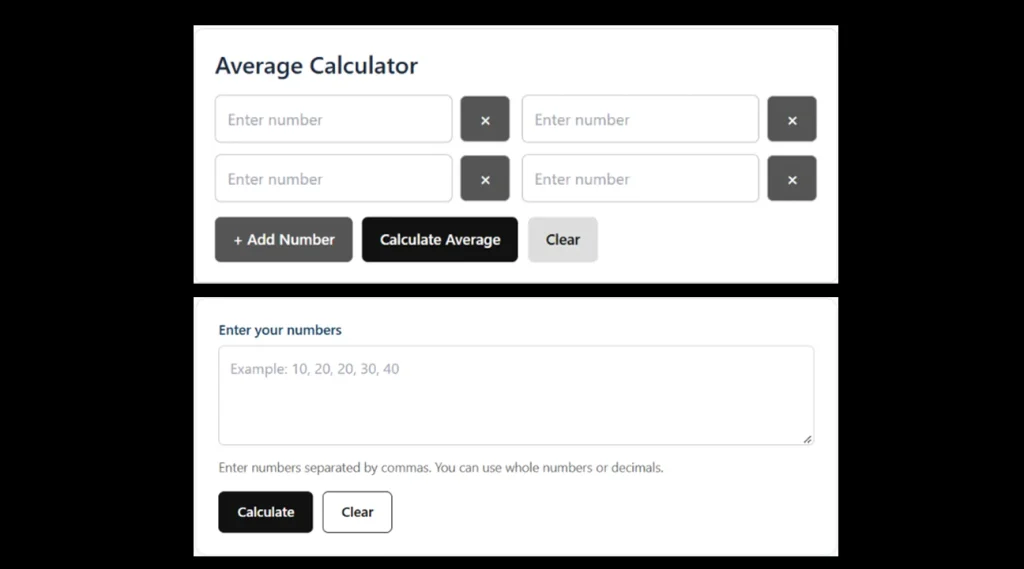
In this guide, we will explain what mean, median, and mode are, how to calculate each one, and when you may want to use them. If you want to calculate an average quickly, you can also use the Average Calculator on NexCalco.
What Is an Average?
An average is a value used to describe a group of numbers. It gives you a simple way to understand a collection of data without looking at every number individually.
For example, consider these five numbers:
10, 20, 30, 40, 50
The numbers are spread across a range, but a single value can help describe the group.
In basic mathematics, the word “average” often refers to the mean. However, mean, median, and mode are all useful measures for describing data.
What Is the Mean?
The mean is calculated by adding all the numbers together and then dividing the total by the number of values.
The formula is:
Mean = Sum of all values ÷ Number of values
For example, suppose you have these numbers:
10, 20, 30, 40, 50
First, add the numbers:
10 + 20 + 30 + 40 + 50 = 150
There are five numbers, so divide 150 by 5:
150 ÷ 5 = 30
Therefore, the mean is 30.
How to Calculate the Mean Step by Step
Calculating the mean involves two simple steps.
Step 1: Add all the numbers
Suppose the values are:
15, 25, 30, 20, 10
Add them together:
15 + 25 + 30 + 20 + 10 = 100
Step 2: Divide by the number of values
There are five numbers:
100 ÷ 5 = 20
So, the mean is 20.
This method works whether you have five numbers or hundreds of values. The basic formula stays the same.
Another Mean Example
Imagine a student receives the following marks in five tests:
72, 85, 68, 90, 75
Add the marks:
72 + 85 + 68 + 90 + 75 = 390
There are five test scores:
390 ÷ 5 = 78
The student’s average score, or mean, is 78.
What Is the Median?
The median is the middle value in a set of numbers after the numbers have been arranged from smallest to largest.
For example:
5, 10, 15, 20, 25
The middle number is 15.
Therefore, the median is 15.
The important thing to remember is that the numbers should be placed in order before finding the median.
How to Calculate the Median With an Odd Number of Values
When there is an odd number of values, there is one number directly in the middle.
For example:
8, 12, 15, 19, 25
There are five values.
The middle value is:
15
Therefore:
Median = 15
Another example:
3, 7, 9, 12, 18, 21, 25
There are seven values, and the fourth value is in the middle.
So:
Median = 12
How to Calculate the Median With an Even Number of Values
When there is an even number of values, there are two numbers in the middle.
In this situation, add the two middle numbers and divide their total by 2.
For example:
10, 20, 30, 40, 50, 60
The two middle values are 30 and 40.
Add them:
30 + 40 = 70
Then divide by 2:
70 ÷ 2 = 35
Therefore, the median is 35.
What Is the Mode?
The mode is the number that appears most often in a set of values.
For example:
4, 7, 7, 10, 12
The number 7 appears twice, while the other numbers appear once.
Therefore:
Mode = 7
The mode is particularly useful when you want to know which value occurs most frequently.
Example of Finding the Mode
Consider this set of numbers:
12, 15, 18, 15, 20, 15, 25
The number 15 appears three times.
The other numbers appear only once.
Therefore:
Mode = 15
Can a Data Set Have More Than One Mode?
Yes. A data set can have two or more modes if multiple values occur the same number of times.
For example:
2, 4, 4, 6, 8, 8, 10
Here, 4 appears twice and 8 also appears twice.
Therefore, the data set has two modes:
Modes = 4 and 8
A set with two modes is sometimes called bimodal.
If several values have the highest frequency, there can also be multiple modes.
Can There Be No Mode?
Yes. If every number appears only once, there is no mode.
For example:
3, 7, 12, 18, 25
Every value occurs once.
Therefore, there is no mode.
Mean vs Median vs Mode
Mean, median, and mode all describe a group of numbers, but they work differently.
| Measure | How It Is Calculated | Best Known For |
|---|---|---|
| Mean | Add values and divide by their count | Overall numerical average |
| Median | Find the middle value after sorting | Middle position |
| Mode | Find the most frequently occurring value | Most common value |
Understanding this difference is important because the three measures can sometimes give very different results.
Example: Comparing Mean, Median and Mode
Consider this data set:
2, 3, 3, 4, 5, 7, 20
Mean
First add all the values:
2 + 3 + 3 + 4 + 5 + 7 + 20 = 44
There are seven values:
44 ÷ 7 = 6.29
So, the mean is approximately 6.29.
Median
The numbers are already arranged from smallest to largest.
The middle value is 4.
So:
Median = 4
Mode
The number 3 appears twice, while the other values appear once.
So:
Mode = 3
In this example:
- Mean = 6.29
- Median = 4
- Mode = 3
This shows why choosing the right measure can matter when looking at data.
Why the Mean Can Be Affected by Large or Small Values
The mean uses every value in the calculation. Because of this, an unusually large or unusually small number can have a noticeable effect on the result.
Consider:
10, 12, 13, 15, 100
The number 100 is much larger than the other values.
The mean is:
(10 + 12 + 13 + 15 + 100) ÷ 5 = 30
The mean becomes 30 even though four of the five values are between 10 and 15.
The median, however, is 13.
This is one reason the median can sometimes give a more representative picture when a data set contains extreme values.
When Should You Use the Mean?
The mean is useful when you want to consider every value in the data set.
Common examples include:
- Average test scores
- Average monthly expenses
- Average sales
- Average production
- Average temperature
- Average time
- Average measurements
For example, if you want to calculate the average score of several tests, the mean gives you a single value based on all the scores.
When Should You Use the Median?
The median is useful when the data contains unusually high or low values.
For example, imagine a group of incomes where most people earn similar amounts but one person earns considerably more.
The very high income can increase the mean substantially. The median may provide a better indication of the middle income in the group.
The median is also useful for data such as:
- Property prices
- Household incomes
- Waiting times
- Delivery times
- Age distributions
- Test results with unusual scores
When Should You Use the Mode?
The mode is useful when you want to know which value occurs most frequently.
For example, a store could look at the most common shoe size sold. A teacher might look at the most frequently selected answer in a survey.
Mode can be useful for:
- Most common size
- Most common response
- Most frequently purchased item
- Survey results
- Repeated categories
- Frequently occurring values
Unlike the mean and median, the mode can also be useful when working with categories rather than numerical measurements.
How to Calculate an Average Quickly
If you only need the basic average, you can use the mean formula:
Average = Total of all values ÷ Number of values
For example:
20, 30, 40, 50
Add the numbers:
20 + 30 + 40 + 50 = 140
There are four values:
140 ÷ 4 = 35
So, the average is 35.
For larger sets of numbers, using an online calculator can make the process faster and reduce the chance of making an arithmetic mistake.
Use an Average Calculator
If you regularly work with numbers, manually adding and dividing values can become time-consuming.
You can use the Average Calculator on NexCalco to calculate the average of a set of numbers quickly.
It is useful when you want to check your calculations or work with a longer list of values.
Use a Mean, Median and Mode Calculator
When you need more than just the average, calculating the three measures separately can take extra time.
The Mean, Median, Mode Calculator can help you find the mean, median, and mode from a set of numbers.
This can be useful for schoolwork, basic data analysis, or checking numerical results.
Common Mistakes When Calculating an Average
A few simple mistakes can change the answer.
Forgetting to Count All Values
When calculating the mean, make sure you count every number in the data set.
Dividing by the Wrong Number
The total should be divided by the number of values, not by the largest value or another number in the list.
Not Sorting Numbers for the Median
Always arrange the numbers from smallest to largest before finding the median.
For example:
20, 5, 15, 10, 25
Should first become:
5, 10, 15, 20, 25
The median is then 15.
Assuming There Is Always One Mode
A data set can have one mode, multiple modes, or no mode at all.
Mean, Median and Mode: A Simple Example
Let’s bring everything together with one example.
Suppose the numbers are:
5, 7, 7, 10, 11
Mean
Add the numbers:
5 + 7 + 7 + 10 + 11 = 40
There are five values:
40 ÷ 5 = 8
Mean = 8
Median
The numbers are already arranged in order.
The middle value is:
7
Median = 7
Mode
The number 7 appears twice.
Mode = 7
Therefore:
Mean = 8
Median = 7
Mode = 7
Final Thoughts
Mean, median, and mode are three simple ways to understand a group of numbers. The mean gives the arithmetic average, the median identifies the middle value, and the mode shows the value that occurs most often.
The right method depends on the type of data you are working with. For a straightforward average, the mean is often the method people have in mind. When extreme values are present, the median can be useful, while the mode helps identify the most frequently occurring value.
Once you understand these three methods, you can use them for everything from school assignments and test scores to everyday comparisons and basic data analysis.
For quick calculations, you can use the Average Calculator or the Mean, Median, Mode Calculator on NexCalco.