Percentages are used in many everyday calculations. You may need them when checking a discount while shopping, calculating exam marks, comparing prices, working out a salary increase, or understanding how much one number has changed.
The good thing is that calculating a percentage is usually quite simple once you understand the basic formula. In this guide, we will explain what a percentage means, show the main percentage formulas, and work through several easy examples.
If you want to calculate percentages quickly without doing the math manually, you can also use the Percentage Calculator on NexCalco.
What Is a Percentage?
A percentage is a way of expressing a number as a part of 100. The word “percent” literally means “per hundred.”
The percentage symbol is %.
For example:
- 25% means 25 out of 100.
- 50% means 50 out of 100.
- 75% means 75 out of 100.
- 100% means the complete amount.
You can also write percentages as fractions or decimals.
For example:
25% = 25/100 = 0.25
Similarly:
60% = 60/100 = 0.60
This relationship between percentages, fractions, and decimals makes percentage calculations easier to understand.
Basic Percentage Formula
The most common percentage formula is:
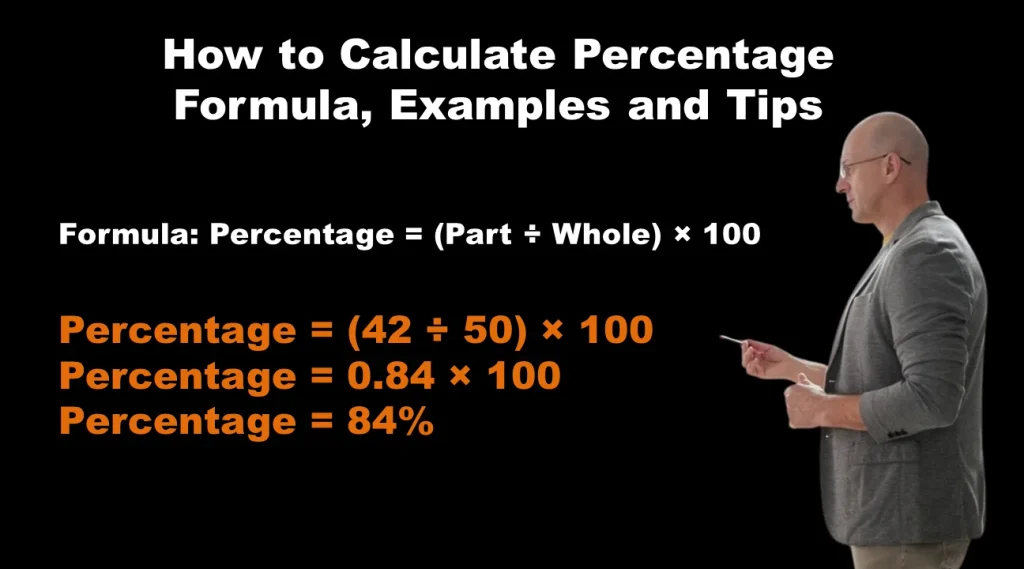
Percentage = (Part ÷ Whole) × 100
Here:
- Part is the amount you are comparing.
- Whole is the total amount.
- 100 converts the result into a percentage.
Example
Suppose a student answers 42 questions correctly out of 50.
Using the formula:
Percentage = (42 ÷ 50) × 100
Percentage = 0.84 × 100
Percentage = 84%
So, the student scored 84%.
How to Calculate What Percentage One Number Is of Another
This is one of the most common percentage calculations.
Suppose you want to know what percentage 30 is of 120.
Use:
Percentage = (30 ÷ 120) × 100
Percentage = 0.25 × 100
Percentage = 25%
Therefore, 30 is 25% of 120.
Another Example
A shop has 80 products, and 20 of them are on sale. What percentage of the products are on sale?
Percentage = (20 ÷ 80) × 100
Percentage = 25%
So, 25% of the products are on sale.
How to Calculate a Percentage of a Number
Sometimes you already know the percentage and want to find the actual amount.
For this calculation, use:
Percentage Amount = (Percentage ÷ 100) × Number
Example
What is 15% of 200?
First, convert 15% into a decimal:
15 ÷ 100 = 0.15
Then multiply:
0.15 × 200 = 30
Therefore:
15% of 200 = 30
Another Example
Suppose you want to calculate 35% of ₹2,000.
35% of ₹2,000 = (35 ÷ 100) × 2,000
= 0.35 × 2,000
= ₹700
So, 35% of ₹2,000 is ₹700.
How to Calculate Percentage Increase
Percentage increase tells you how much a value has gone up compared with its original value.
The formula is:
Percentage Increase = [(New Value − Original Value) ÷ Original Value] × 100
Example
Suppose the price of a product increases from ₹500 to ₹600.
First, find the increase:
₹600 − ₹500 = ₹100
Now calculate the percentage increase:
(₹100 ÷ ₹500) × 100 = 20%
So, the price increased by 20%.
Another Example
A monthly salary increases from ₹30,000 to ₹33,000.
Increase:
₹33,000 − ₹30,000 = ₹3,000
Percentage increase:
(₹3,000 ÷ ₹30,000) × 100 = 10%
The salary increased by 10%.
How to Calculate Percentage Decrease
Percentage decrease works in a similar way. It tells you how much a value has fallen compared with its original value.
The formula is:
Percentage Decrease = [(Original Value − New Value) ÷ Original Value] × 100
Example
A product originally costs ₹1,000 but is now available for ₹800.
First, calculate the decrease:
₹1,000 − ₹800 = ₹200
Now:
(₹200 ÷ ₹1,000) × 100 = 20%
Therefore, the price has decreased by 20%.
How to Calculate a Discount Percentage
Discounts are another common use of percentages.
The discount percentage can be calculated using:
Discount Percentage = (Discount Amount ÷ Original Price) × 100
Example
A jacket originally costs ₹2,500 and is sold for ₹2,000.
Discount:
₹2,500 − ₹2,000 = ₹500
Discount percentage:
(₹500 ÷ ₹2,500) × 100 = 20%
So, the jacket has a 20% discount.
How to Find the Price After a Discount
If you know the original price and discount percentage, you can calculate the final price.
For example, suppose a product costs ₹1,500 and has a 20% discount.
First calculate the discount:
20% of ₹1,500 = ₹300
Then subtract it from the original price:
₹1,500 − ₹300 = ₹1,200
The final price is ₹1,200.
How to Calculate Percentage Change
Percentage change is useful when comparing an old value with a new value.
The general formula is:
Percentage Change = [(New Value − Old Value) ÷ Old Value] × 100
If the result is positive, the value increased. If the result is negative, the value decreased.
Example
A website receives 4,000 visitors in one month and 5,000 visitors the following month.
Change:
5,000 − 4,000 = 1,000
Percentage change:
(1,000 ÷ 4,000) × 100 = 25%
Therefore, the number of visitors increased by 25%.
How to Convert a Decimal Into a Percentage
Converting a decimal into a percentage is easy.
Simply multiply the decimal by 100 and add the percentage symbol.
Percentage = Decimal × 100
Examples
0.25 × 100 = 25%
0.50 × 100 = 50%
0.75 × 100 = 75%
0.08 × 100 = 8%
So:
0.08 = 8%
How to Convert a Percentage Into a Decimal
To convert a percentage into a decimal, divide it by 100.
Examples
25% ÷ 100 = 0.25
50% ÷ 100 = 0.50
75% ÷ 100 = 0.75
8% ÷ 100 = 0.08
A useful shortcut is to move the decimal point two places to the left.
For example:
45% → 0.45
7% → 0.07
125% → 1.25
How to Calculate Exam Percentage
Percentage is frequently used to calculate exam or test scores.
The formula is:
Exam Percentage = (Marks Obtained ÷ Total Marks) × 100
Example
Suppose a student scores 425 marks out of 500.
Percentage = (425 ÷ 500) × 100
= 85%
The student’s percentage is 85%.
If the total marks are different for different exams, always use the actual total marks when calculating the percentage.
How to Calculate Profit Percentage
Percentage calculations are also useful when calculating profit.
The basic formula is:
Profit = Selling Price − Cost Price
Then:
Profit Percentage = (Profit ÷ Cost Price) × 100
Example
Suppose a product is purchased for ₹800 and sold for ₹1,000.
Profit:
₹1,000 − ₹800 = ₹200
Profit percentage:
(₹200 ÷ ₹800) × 100 = 25%
So, the profit is 25% of the cost price.
How to Calculate Loss Percentage
If an item is sold for less than its cost price, you have a loss.
The formula is:
Loss = Cost Price − Selling Price
Then:
Loss Percentage = (Loss ÷ Cost Price) × 100
Example
A product costs ₹1,200 but is sold for ₹1,080.
Loss:
₹1,200 − ₹1,080 = ₹120
Loss percentage:
(₹120 ÷ ₹1,200) × 100 = 10%
Therefore, the loss is 10%.
Percentage Calculation Quick Reference
Here are some of the most useful formulas in one place:
| Calculation | Formula |
|---|---|
| Basic percentage | (Part ÷ Whole) × 100 |
| Percentage of a number | (Percentage ÷ 100) × Number |
| Percentage increase | [(New − Original) ÷ Original] × 100 |
| Percentage decrease | [(Original − New) ÷ Original] × 100 |
| Discount percentage | (Discount ÷ Original Price) × 100 |
| Profit percentage | (Profit ÷ Cost Price) × 100 |
| Loss percentage | (Loss ÷ Cost Price) × 100 |
| Decimal to percentage | Decimal × 100 |
| Percentage to decimal | Percentage ÷ 100 |
Common Percentage Mistakes to Avoid
Percentage calculations are simple, but small mistakes can lead to incorrect results. Keep these points in mind.
1. Using the Wrong Total
When finding what percentage one number is of another, the number you divide by should normally be the whole or original amount.
For example, if a price changes from ₹500 to ₹600, the percentage increase is based on ₹500, not ₹600.
2. Forgetting to Multiply by 100
If you calculate:
30 ÷ 120 = 0.25
The answer is not 0.25% when you are looking for a percentage.
You need to multiply by 100:
0.25 × 100 = 25%
3. Confusing Percentage With Percentage Points
These two terms are not always interchangeable.
For example, if a rate changes from 20% to 25%, the increase is 5 percentage points. The relative increase compared with the original 20% is 25%.
4. Using the New Value Instead of the Original Value
For percentage increases and decreases, the original value is generally the reference point.
For example, if a price rises from ₹400 to ₹500:
Increase = ₹100
Percentage increase = (₹100 ÷ ₹400) × 100 = 25%
Using ₹500 as the denominator would give a different result.
Tips for Calculating Percentages Faster
You do not always need a calculator for simple percentages. Some common percentages can be worked out quickly.
Find 10%
Move the decimal point one place to the left.
For example:
10% of 500 = 50
Find 5%
Calculate 10% and divide it by 2.
For example:
10% of 500 = 50
5% of 500 = 25
Find 1%
Move the decimal point two places to the left.
For example:
1% of 500 = 5
Find 50%
Simply divide the number by 2.
For example:
50% of 800 = 400
Find 25%
Divide the number by 4.
For example:
25% of 800 = 200
These shortcuts are useful for quick mental calculations, especially when dealing with discounts, prices, or simple comparisons.
Why Percentage Calculations Are Useful
Percentages are used in many areas of daily life and work. Some common examples include:
- Calculating shopping discounts
- Comparing price changes
- Checking exam scores
- Calculating salary increases
- Understanding business profits and losses
- Comparing sales figures
- Working out tax amounts
- Tracking changes in website traffic
- Understanding interest and financial figures
- Comparing different quantities
Once you understand the basic formula, many of these calculations become much easier.
Use a Percentage Calculator
For simple calculations, doing the math by hand can be useful for learning the formula. However, a calculator can save time when you need to perform several calculations or work with larger numbers.
You can use the Percentage Calculator on NexCalco to calculate percentages quickly and conveniently.
It can be especially useful when you want to check a result without working through the calculation manually.
Final Thoughts
Calculating a percentage mainly comes down to understanding the relationship between a part and a whole. The most important formula to remember is:
Percentage = (Part ÷ Whole) × 100
From this basic formula, you can calculate exam scores, discounts, increases, decreases, profits, losses, and many other everyday values.
The key is to identify the correct numbers before starting the calculation. Once you know which number represents the part and which represents the whole or original value, the calculation is usually straightforward.