A ratio is a basic mathematical concept used to compare two or more quantities. We use ratios in many everyday situations, such as comparing prices, mixing ingredients, calculating distances, managing expenses, and understanding proportions. Ratios make it easier to see how one quantity relates to another.
Whether you are a student learning mathematics or someone who uses numbers in daily activities, understanding ratios can help you solve different types of problems more easily.
In this article, we will explain what a ratio is, its formula, different types, calculation methods, and practical examples.
What Is a Ratio?
A ratio is a comparison between two or more quantities of the same kind. It shows how much of one quantity exists in relation to another.
For example, imagine a classroom has 15 boys and 10 girls. The ratio of boys to girls is 15:10. This means that for every 15 boys, there are 10 girls.
Ratios can be written in three common ways:
- Using a colon: 15:10
- Using the word “to”: 15 to 10
- Using a fraction: 15/10
A ratio does not always need to compare equal quantities. However, the quantities should be expressed in the same units before making a direct comparison.
Also Read: Greek Alphabet Letters and Symbols: Complete Table with Meanings
What Is the Formula for a Ratio?
The basic ratio formula is:
Ratio = First Quantity : Second Quantity
If two quantities are represented by A and B, the ratio can be written as:
A : B
For example, if a person has 20 red balls and 30 blue balls, the ratio of red balls to blue balls is:
20:30
To simplify this ratio, divide both numbers by their greatest common divisor (GCD), which is 10.
20 ÷ 10 = 2
30 ÷ 10 = 3
Therefore, the simplified ratio is 2:3.
This means that for every 2 red balls, there are 3 blue balls.
How to Calculate a Ratio
Calculating a ratio is simple when you follow a few basic steps.
Step 1: Identify the quantities you want to compare.
Step 2: Write the quantities in the correct order.
Step 3: Make sure both quantities use the same unit.
Step 4: Find the greatest common divisor of the numbers.
Step 5: Divide both quantities by the GCD to simplify the ratio.
Example:
Suppose a shop sells 24 notebooks and 36 pens. What is the ratio of notebooks to pens?
Step 1: Write the ratio.
24:36
Step 2: Find the GCD of 24 and 36.
GCD = 12
Step 3: Divide both numbers by 12.
24 ÷ 12 = 2
36 ÷ 12 = 3
The final ratio is 2:3.
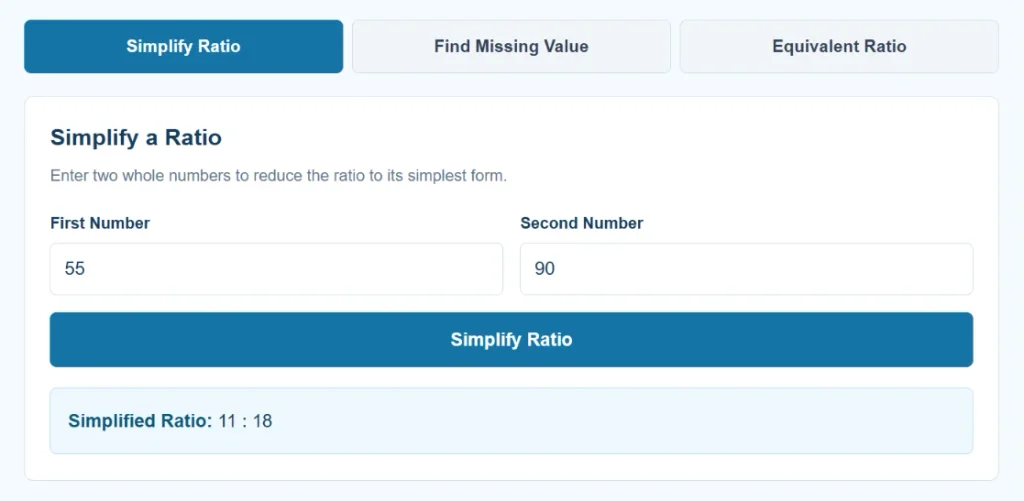
You can also use an online Ratio Calculator to calculate and simplify ratios without doing the calculations manually. This can be helpful when working with larger numbers or checking your answers.
Also Read: How to Use the NATO Phonetic Alphabet for Clear Communication
Different Types of Ratios
Ratios can be classified into different types depending on the relationship between the quantities being compared.
1. Simple Ratio
A simple ratio compares two quantities.
For example, if there are 8 apples and 12 oranges, the ratio of apples to oranges is 8:12.
After simplification, it becomes 2:3.
2. Compound Ratio
A compound ratio is formed by combining two or more ratios. It is useful when comparing multiple relationships.
For example:
- First ratio = 2:3
- Second ratio = 4:5
The compound ratio is calculated by multiplying the corresponding terms:
(2 × 4):(3 × 5)
The answer is 8:15.
3. Equivalent Ratios
Equivalent ratios are different ratios that represent the same relationship.
For example:
2:3, 4:6, 6:9 and 8:12
All these ratios are equivalent because they can be simplified to 2:3.
Equivalent ratios are commonly used in mathematics, cooking, measurements, and scaling.
4. Inverse Ratio
An inverse ratio is formed by reversing the order of the quantities.
For example, if the original ratio is 3:5, its inverse ratio is 5:3.
The order of quantities is important because reversing a ratio changes the relationship being described.
5. Duplicate Ratio
A duplicate ratio is obtained by squaring both terms of a given ratio.
For example:
Original ratio = 2:3
Duplicate ratio = 2²:3²
Answer = 4:9
6. Triplicate Ratio
A triplicate ratio is obtained by cubing both terms of a given ratio.
For example:
Original ratio = 2:3
Triplicate ratio = 2³:3³
Answer = 8:27
What Is the Difference Between Ratio and Proportion?
Ratio and proportion are closely related mathematical concepts, but they are not exactly the same.
A ratio compares two quantities, while a proportion shows that two ratios are equal.
For example:
Ratio: 2:3
Another Ratio: 4:6
Since both ratios represent the same relationship, they form a proportion.
It can be written as:
2:3 = 4:6
Proportions are often used to solve problems involving unknown values, scaling, and comparisons.
Also Read: What Is Lorem Ipsum? A Simple Guide to Placeholder Text
Real-Life Uses of Ratios
Ratios are not limited to classroom mathematics. They are useful in many practical situations.
1. Cooking and Food Preparation
Ratios help maintain the correct balance of ingredients in recipes.
For example, if a recipe requires 2 cups of flour and 1 cup of sugar, the ratio of flour to sugar is 2:1.
If you want to prepare a larger quantity, you can increase both ingredients while maintaining the same ratio.
2. Business and Finance
Businesses use ratios to compare revenue, expenses, profits, and other financial figures.
For example, a business may compare its income with its expenses to understand its financial performance. Financial ratios also help investors and business owners evaluate different aspects of a company’s performance.
3. Shopping and Price Comparison
Ratios can help compare the quantities and prices of products.
For example, if one package contains 500 grams of rice and another contains 1,000 grams, their quantity ratio is 1:2.
This type of comparison can help shoppers understand product quantities and value.
4. Education and Classrooms
Teachers use ratios to compare the number of students, boys and girls, books, and other classroom resources.
For example, if a class has 20 boys and 25 girls, the ratio of boys to girls is 20:25, which simplifies to 4:5.
5. Maps and Scale Drawings
Ratios are important in maps, architectural plans, and engineering drawings.
For example, a map scale of 1:100,000 means that 1 unit on the map represents 100,000 of the same units in real life.
This helps people understand actual distances from smaller drawings or maps.
6. Sports and Fitness
Ratios are also useful in sports and fitness activities.
For example, a coach may compare successful attempts with total attempts to understand a player’s performance. Athletes may also use ratios when adjusting workout plans, training schedules, and nutritional measurements.
7. Mixing Paints and Liquids
Ratios help maintain the correct proportions when mixing different liquids or materials.
For example, if two parts of white paint are mixed with one part of blue paint, the mixing ratio is 2:1.
Maintaining this ratio helps produce a consistent mixture.
How to Simplify a Ratio
Simplifying a ratio means reducing it to its smallest possible whole-number form without changing the relationship between the quantities.
Follow these steps:
Example: Simplify 45:60
Step 1: Identify both numbers.
45 and 60
Step 2: Find their greatest common divisor.
GCD = 15
Step 3: Divide both numbers by 15.
45 ÷ 15 = 3
60 ÷ 15 = 4
Final Answer: 3:4
The ratio 45:60 and 3:4 represent the same relationship, but 3:4 is the simplest form.
Common Mistakes to Avoid When Calculating Ratios
Although ratios are easy to understand, some common mistakes can lead to incorrect answers.
- Reversing the order: A ratio of boys to girls is different from a ratio of girls to boys.
- Ignoring units: Convert measurements into the same unit before comparing them.
- Incorrect simplification: Divide all terms by the same common factor.
- Confusing ratios with differences: A ratio compares quantities through division, whereas a difference is calculated through subtraction.
- Forgetting to simplify: Always check whether the numbers can be reduced further.
Avoiding these mistakes can make ratio calculations more accurate and easier to understand.
Conclusion
A ratio is a useful mathematical tool for comparing two or more quantities. From cooking and shopping to business, education, sports, and measurements, ratios help us understand relationships between numbers.
Learning how to calculate, simplify, and use different types of ratios can make many mathematical problems easier to solve. With regular practice and the right calculation methods, anyone can become comfortable working with ratios.
For quick calculations, an online Ratio Calculator can also help simplify numbers and check results, saving time when solving everyday mathematical problems.