The Greek alphabet is a set of 24 letters that originated in ancient Greece and is still widely used today. These letters are commonly seen in mathematics, science, physics, engineering, and statistics. Some familiar examples include Alpha (α), Beta (β), Pi (π), Delta (Δ), and Omega (Ω).
Each Greek letter has an uppercase and a lowercase form, and many letters have special meanings depending on the subject. For example, Pi (π) represents the ratio of a circle’s circumference to its diameter, while Delta (Δ) often represents a change in a quantity.
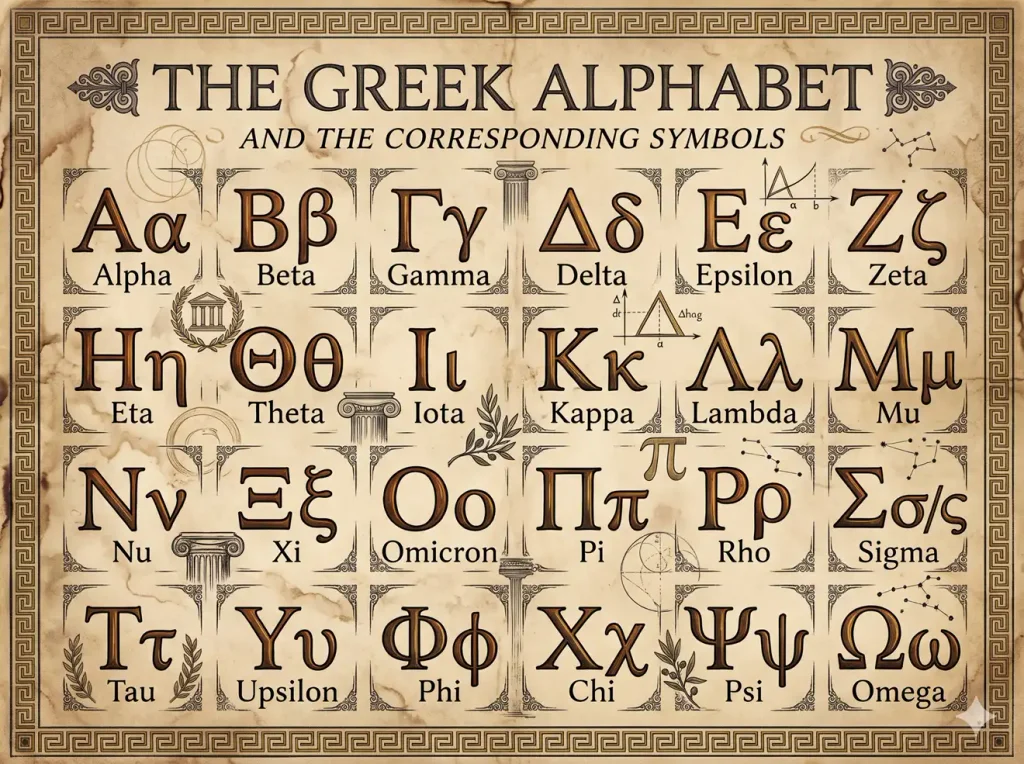
Greek Alphabet Letters and Symbols Table
The following table lists all 24 Greek alphabet letters, along with their uppercase symbols, lowercase symbols, and names.
| No. | Greek Letter | Uppercase | Lowercase | Common Use or Meaning |
|---|---|---|---|---|
| 1 | Alpha | Α | α | Angles, coefficients |
| 2 | Beta | Β | β | Beta particles, coefficients |
| 3 | Gamma | Γ | γ | Gamma rays, angles |
| 4 | Delta | Δ | δ | Change, differences |
| 5 | Epsilon | Ε | ε | Small quantities, error |
| 6 | Zeta | Ζ | ζ | Mathematical functions |
| 7 | Eta | Η | η | Efficiency |
| 8 | Theta | Θ | θ | Angles |
| 9 | Iota | Ι | ι | Small quantities |
| 10 | Kappa | Κ | κ | Curvature, constants |
| 11 | Lambda | Λ | λ | Wavelength |
| 12 | Mu | Μ | μ | Micro prefix, mean |
| 13 | Nu | Ν | ν | Frequency |
| 14 | Xi | Ξ | ξ | Variables in mathematics |
| 15 | Omicron | Ο | ο | Mathematical notation |
| 16 | Pi | Π | π | Circle constant (3.14159…) |
| 17 | Rho | Ρ | ρ | Density |
| 18 | Sigma | Σ | σ | Summation, standard deviation |
| 19 | Tau | Τ | τ | Time constants |
| 20 | Upsilon | Υ | υ | Mathematical notation |
| 21 | Phi | Φ | φ | Angles, golden ratio notation |
| 22 | Chi | Χ | χ | Chi-square statistics |
| 23 | Psi | Ψ | ψ | Wave functions |
| 24 | Omega | Ω | ω | Ohms, angular frequency |
Note: The meaning of a Greek symbol depends on the context. The same letter may represent different things in different subjects.
Frequently Asked Questions
1. How many letters are in the Greek alphabet?
The Greek alphabet has 24 letters, starting with Alpha (Α, α) and ending with Omega (Ω, ω).
2. What are Greek alphabet symbols used for?
Greek symbols are used in mathematics, physics, chemistry, engineering, astronomy, and statistics. They often represent variables, angles, constants, scientific quantities, and mathematical operations.
3. What is the difference between uppercase and lowercase Greek letters?
Uppercase letters are the capital forms, while lowercase letters are their smaller forms. For example, Delta has the uppercase symbol Δ and the lowercase symbol δ. Their meanings may differ depending on the subject.
4. Which Greek letter represents Pi?
Pi is written as π in lowercase and Π in uppercase. The lowercase symbol π represents the mathematical constant approximately equal to 3.14159.
5. Which Greek letter represents change?
Delta is commonly used to represent a change or difference in a quantity. Uppercase Delta (Δ) often represents a finite change, such as Δx, meaning the change in x.
6. Which Greek letter represents wavelength?
The lowercase letter Lambda (λ) is commonly used to represent wavelength in physics, especially when discussing light, sound, and other waves.
7. Are Greek letters used in everyday life?
Yes. Greek letters appear in scientific formulas, electrical measurements, academic subjects, fraternity and sorority names, and technical documents. For example, Ω (Omega) is used as the symbol for ohms, the unit of electrical resistance.
8. Can I copy and paste Greek alphabet symbols?
Yes. You can copy any uppercase or lowercase symbol directly from the table above and paste it into documents, websites, presentations, notes, or messages. Some symbols may display differently depending on the font or device.
Related Articles
How to Use the NATO Phonetic Alphabet for Clear Communication
Text Case Converter: How to Change Uppercase, Lowercase, and Title Case