Have you ever tried spelling your name over the phone, only to find that the other person heard a completely different letter? Words that sound similar can easily cause confusion, especially during a phone call, in a noisy environment, or when communicating with someone who speaks a different language.
The NATO phonetic alphabet helps solve this problem by assigning a specific code word to each letter of the English alphabet. Instead of saying a letter on its own, you use a recognizable word that makes it easier for the listener to identify the correct letter.
From aviation and emergency services to military operations and everyday phone conversations, this system provides a practical way to communicate letters accurately. Understanding how it works can help you avoid spelling mistakes and make important conversations more reliable.
What Is the NATO Phonetic Alphabet?
The NATO phonetic alphabet is a standardized system used to represent the 26 letters of the English alphabet through spoken words. It begins with Alpha for A and ends with Zulu for Z.
For example, the letters B, D, P, and T can sometimes sound similar over a telephone connection. Using the code words Bravo, Delta, Papa, and Tango makes the intended letters easier to distinguish.
Although commonly called a phonetic alphabet, it is technically a spelling alphabet. It is designed to communicate letters clearly rather than describe the individual sounds used in linguistics.
The system is widely associated with NATO, aviation, military communication, and other situations where accuracy matters. Its standardized vocabulary helps people communicate across different accents, radio conditions, and language backgrounds.
The NATO Phonetic Alphabet From A to Z
Learning the code words is the first step toward using the system confidently.
| Letter | Code word | Letter | Code word |
|---|---|---|---|
| A | Alfa | N | November |
| B | Bravo | O | Oscar |
| C | Charlie | P | Papa |
| D | Delta | Q | Quebec |
| E | Echo | R | Romeo |
| F | Foxtrot | S | Sierra |
| G | Golf | T | Tango |
| H | Hotel | U | Uniform |
| I | India | V | Victor |
| J | Juliett | W | Whiskey |
| K | Kilo | X | X-ray |
| L | Lima | Y | Yankee |
| M | Mike | Z | Zulu |
Two spellings are worth noticing: the standardized forms are Alfa and Juliett, rather than the more familiar spellings “Alpha” and “Juliet.” These forms are intended to support consistent pronunciation across languages.
You do not need to memorize every word immediately. Start with frequently confused letters, then gradually practice the entire alphabet.
How to Use the NATO Phonetic Alphabet
Using the system is simple once you understand the basic principle: replace each letter you need to communicate with its corresponding code word.
1. Spell Names Clearly
Names are among the most common reasons people spell things aloud. A surname, for example, may be unfamiliar to the listener or difficult to understand over the phone.
Suppose your name is Daniel. You can spell it as:
Delta – Alfa – November – India – Echo – Lima
Each word represents one letter in the name. This approach reduces the chance that the listener will confuse one letter with another.
2. Communicate Email Addresses
Email addresses often contain combinations of letters, numbers, periods, underscores, and other symbols. A single incorrect character can make an address unusable.
If you need to spell the username “mike27,” you could say:
Mike – India – Kilo – Echo – Two – Seven
You should also describe punctuation explicitly when necessary, such as saying “at sign” or “dot.” The NATO alphabet represents letters; it does not replace the need to communicate numbers and symbols clearly.
3. Share Reference Numbers and Codes
Customer support teams, technical staff, delivery services, and administrative departments may need to exchange reference codes over the phone.
If a code contains letters that sound alike, using the standardized words can help both parties record the correct information. For long codes, communicate the characters in small groups and ask the listener to repeat them when accuracy is important.
For sensitive information, follow the organization’s approved security procedures rather than sharing confidential codes through an unverified channel.
4. Improve Radio Communication
Radio transmissions can be affected by background noise, weak signals, interference, and distance. Under these conditions, individual letters may become difficult to understand.
The NATO phonetic alphabet provides a common vocabulary that helps reduce ambiguity. It is therefore useful in aviation, maritime communication, emergency response, and military settings where incorrect information can have serious consequences.
Why Is the NATO Phonetic Alphabet Important?
The biggest advantage of the NATO phonetic alphabet is consistency. When people use different words to describe the same letter, misunderstandings become more likely. A standardized system gives everyone a shared reference.
It offers several practical benefits:
- Fewer spelling errors: Distinctive code words make individual letters easier to identify.
- Clearer phone conversations: The system is helpful when audio quality is poor or accents differ.
- More reliable teamwork: People working across departments or countries can use the same spelling conventions.
- Better handling of important information: Names, identifiers, and reference codes can be communicated more accurately.
- Easy international recognition: The standardized words are widely used in professional communication.
The system cannot eliminate every mistake, but it makes letter-by-letter communication more dependable.
How to Practice the NATO Phonetic Alphabet
Regular practice is more effective than trying to memorize the entire alphabet in one sitting.
Start by learning five letters at a time. Read each letter alongside its code word, then practice spelling familiar names, cities, and everyday words aloud.
Next, ask someone to read a short sequence of code words while you write down the corresponding letters. Reverse the exercise by spelling words aloud and asking the other person to identify them.
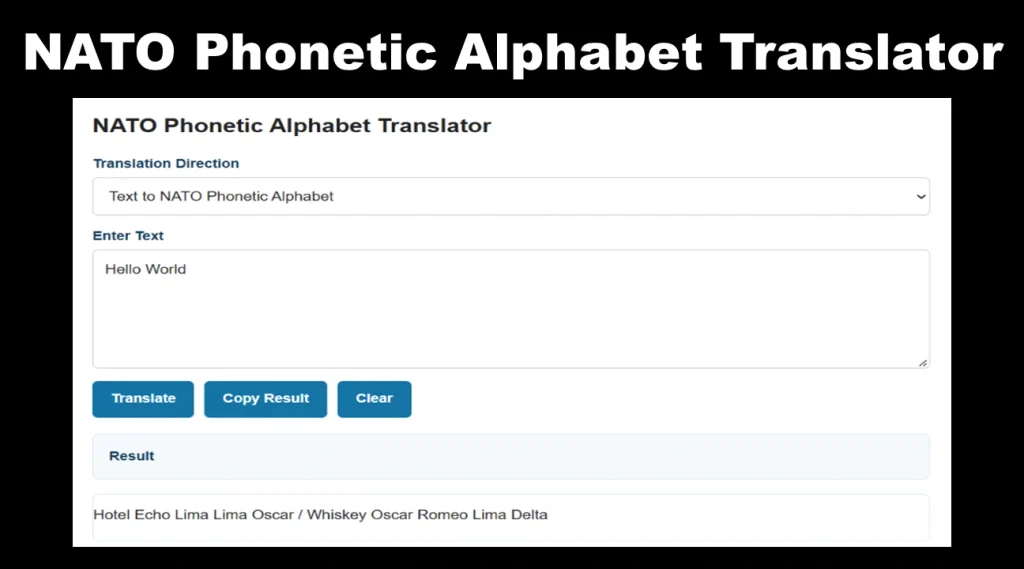
You can also use an online NATO Phonetic Alphabet Translator to help convert text into the corresponding phonetic code words. This is a convenient way to check your spelling, practice unfamiliar sequences, and become more comfortable with the system.
As your confidence improves, practice longer names, email addresses, and mixed letter-and-number codes. Focus on accuracy first; speed will come naturally with repetition.
Common Mistakes to Avoid
Even a simple communication system works best when used carefully.
One common mistake is inventing personal code words instead of using the standardized terms. Another is speaking too quickly, causing the listener to miss individual words.
It is also important to distinguish letters from numbers and punctuation. For example, spelling an email address requires you to communicate the letters as well as the symbols between them.
Finally, do not assume that the listener has understood every character. For important information, ask them to read the sequence back to you so you can verify it.
Final Thoughts
The NATO phonetic alphabet is a straightforward but valuable tool for clear communication. By replacing individual letters with standardized code words, it helps people spell names, exchange reference codes, and communicate more reliably over phones and radios.
Whether you need it for professional work, travel, customer service, or everyday conversations, learning the alphabet can save time and prevent avoidable misunderstandings.
With a little practice and the help of an online NATO Phonetic Alphabet Translator, you can start using the system confidently whenever accurate spelling matters.